 By Nikhil kumar pandey & Editorial Guild
The Cold Bite of Dawn at Assi Ghat
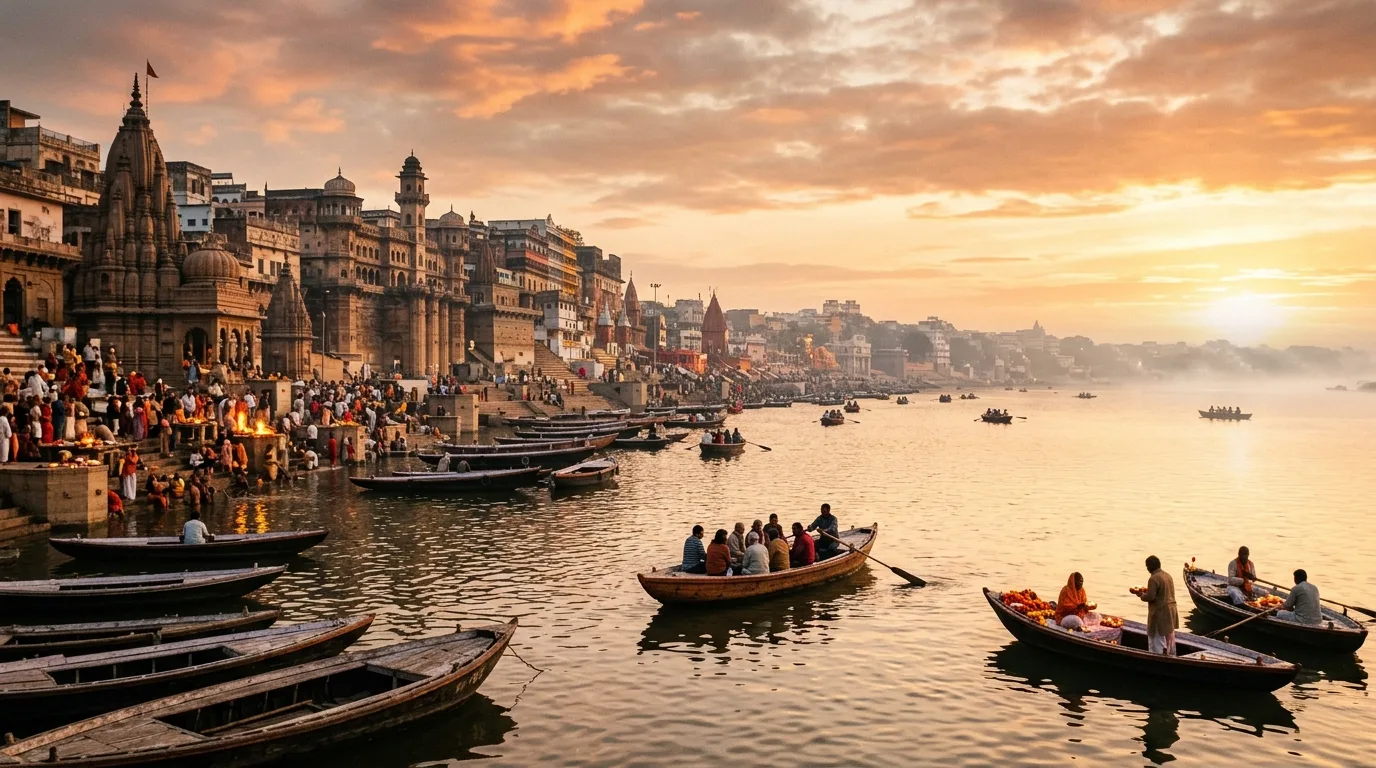
If you arrive at Assi Ghat past 5:00 AM, the cold morning wind cuts right through your jacket. The river was black. The steps were slick with morning condensation and river spray. Wooden oars clanked against gunwales as boatmen untied their tied-up skiffs. A stray dog shivered near a dormant tea stall waiting for the charcoal stove to fire up. The air carried the sharp, unmistakable sting of burning camphor and wet cow dung cakes. You pull your collar tighter. There's no poetry in the freezing limestone until the first orange sliver slices the eastern horizon.
Subah-e-Banaras isn't just a performance for camera-toting outsiders. It's an unyielding daily rhythm where flutes echo across empty water and hundreds sit wrapped in woolens on stone terraces. You'll want to grab a scalding kulhad chai infused with crushed black pepper and fresh ginger for ₹10 from the corner vendor. He won't speak English, and he'll definitely try to hand you a second one if you linger. Don't rush down to the water yet. Let the mist burn off slowly.
Booking a hand-rowed wooden boat costs ₹400 to ₹700 per hour for a small group of two to four people. The boatman will quote ₹800 first. Drop it down without arguing; it's just part of the morning negotiation ritual. A private wooden rowboat takes you past empty bathing ghats while the city above you slowly begins to clear its throat with a chorus of temple bells and sweeping brooms.
Shiva, Parvati, and the Architecture of Moksha
Kashi isn't just a geography city. It's believed to sit outside the cosmic dissolution, held aloft on the trident of Lord Shiva. According to local lore passed down through generations of Sanskrit scholars, Lord Shiva and Goddess Parvati made this sacred ground their permanent home. When an ordinary mortal breathes their last breath within the holy boundaries of the Panchakoshi circuit, Shiva himself whispers the Taraka mantra into their ear. That's the core of Moksha here.
It isn't about luxury or scenic sunsets. It's about a hard, unyielding confrontation with mortality that you won't find anywhere else on the planet. The narrow, labyrinthine galis—alleys so tight two bicycles barely pass—lead past shrines that predate modern European capitals. You'll dodge sacred cows, motorbikes squeezing through impossible gaps, and overhead tangles of green electricity wires. Wear sturdy walking shoes. The stone paving is uneven, perpetually damp, and occasionally slick with spilled milk from morning abhishek offerings.
If you want to bypass the chaotic street grid for your temple transit, the Varanasi Urban Public Ro-way offers a sleek alternative. It connects Varanasi Cantt Railway Station directly to Godowlia Chowk across a 3.8 km aerial span in just 15 to 17 minutes. Modern Swiss-Austrian air-conditioned gondolas run from 06:00 AM to 10:00 PM for an affordable ticket price of ₹50 to ₹80 per passenger. It saves you from forty-five minutes of heavy street gridlock.
Tulsi Manas Mandir and the Echoes of the Ramcharitmanas
Step away from the riverfront for an hour and head south toward Durgakund to find Tulsi Manas Mandir. This white marble temple marks the exact spot where the sixteenth-century saint-poet Tulsidas composed the Awadhi epic Ramcharitmanas. The walls inside aren't covered in standard mythological paintings. Instead, entire verses of the epic are engraved meticulously into the marble panels. The atmosphere here feels distinctly different from the chaotic energy of the riverbanks—quieter, more scholarly, smelling faintly of old paper and brass polish.
Take an auto-rickshaw from Godowlia for ₹100 to ₹150, or grab a shared e-rickshaw for ₹20 per passenger if you prefer local transit. The temple grounds feature well-kept gardens where old men sit cross-legged under neem trees reciting verses from memory. It's a wonderful counterweight to the intense sensory overload of the main ghats. You don't need a guide here; just walk slowly around the central courtyard and let the marble coolness calm your feet.
Pair your temple visit with a heavy breakfast nearby. A plate of piping hot kachori sabzi paired with sweet jalebi costs ₹40 to ₹60 at local legendary counters. Wash it down with a thick kulhad lassi priced at ₹50 to ₹80. It's rich, heavy, and will require a solid two-hour walk to digest properly.
Harishchandra Ghat: The Unflinching Reality of the Fires
Photography is strictly prohibited here for obvious reasons. Harishchandra Ghat is one of the two primary cremation grounds where funeral pyres burn continuously, day and night, without a single pause. The air smells of dry sandalwood, burning cedar, and heavy woodsmoke. Logs are stacked in precise geometric towers by the riverbank. Grieving families sit silently on stone benches while boat traffic drifts quietly past at a respectful distance.
This isn't a tourist attraction. It's the physical manifestation of the legend of King Harishchandra, who surrendered his throne, family, and personal freedom to uphold truth, eventually working as a caretaker at these very cremation grounds. The fires here represent the final transit of the soul. Watching the sparks rise against the dark stone facade of the old buildings forces a stark, sobering meditation on the transience of human ego. Walk softly. Keep your phone in your pocket.
When you emerge back into the brightly lit alleys near Godowlia, the contrast is jarring. Street vendors are frying tamatar chaat in massive iron woks for ₹50 to ₹70 a plate. The smell of roasted cumin and tamarind overpowers the smoke from the river in minutes. Life surges right back over you with deafening urgency.
Morning Versus Evening: The Dual Face of Kashi
The city changes its entire personality between dawn and dusk. Mornings belong to the bathers, the yogis, the old men chanting Sanskrit hymns on stone platforms, and the silent mist rising off the river. Evenings belong to brass lamps, thunderous percussion, crowds packed shoulder-to-shoulder on anchored wooden boats, and the blazing spectacle of the Ganga Aarti at Dashashwamedh Ghat.
If you want a prime, unobstructed view of the evening aarti without being elbowed by selfie-seekers, book a seat on an AC electric cruise like the Alaknanda or MV Bhagirathi for ₹800 to ₹1,200 per passenger. These cruises include live classical music, light snacks, and a stationary view right in front of the main ritual stage. Alternatively, a shared motorboat costs ₹100 to ₹200 per seat, though you'll be rocking in the wake of dozens of other vessels.
For general public darshan at the Shri Kashi Vishwanath Dham corridor, entry is 100% free. If you want to skip the massive serpentine queues, book a Sugam Darshan priority pass for ₹300 per person online or directly at Gate 4. Remember that mobile phones, leather belts, and large bags are strictly prohibited inside the inner sanctum. Use the free digital locker tokens provided at the entrance gates to stash your gear safely before stepping into the gold-plated corridors.
Frequently Asked Questions
How much does a private wooden boat ride cost on the Ganga river?
A hand-rowed wooden boat ride typically costs between ₹400 and ₹700 per hour for two to four passengers. Boatmen often quote ₹800 to ₹1,000 during peak sunrise or evening aarti hours, so always negotiate the final fare before stepping onto the vessel.
Is there a metro or ropeway system operating in Varanasi?
Varanasi features an urban public ropeway connecting Varanasi Cantt Railway Station directly to Godowlia Chowk. This aerial transit system spans approximately 3.8 to 4.2 km across five stations, operating from 06:00 AM to 10:00 PM with tickets priced between ₹50 and ₹80 per passenger.
Can I visit the Shri Kashi Vishwanath Temple for free?
General public darshan at the Shri Kashi Vishwanath temple is entirely free of charge. Travelers wishing to skip the standard queue can purchase a Sugam Darshan priority entry pass for ₹300 per person via the official temple portal or at Gate 4.
What are the local street food prices in Varanasi?
A plate of kachori sabzi with jalebi costs between ₹40 and ₹60 at heritage stalls like Ram Bhandar. Tamatar chaat is priced at ₹50 to ₹70, a clay kulhad of lassi costs ₹50 to ₹80, and traditional kulhad chai is readily available for ₹10 per cup.
How do I get from Varanasi Babatpur Airport to the city center?
Prepaid airport taxis from VNS Babatpur to central Varanasi cost between ₹800 and ₹1,000. App-based cabs like Ola and Uber range from ₹700 to ₹900, while budget-conscious travelers can board the air-conditioned electric airport bus for just ₹50.
Varanasi Travel Quick Reference: Timings, Costs & Essentials
Key verified facts for planning your visit to Varanasi — timings, transport costs, temple guidelines, and safety tips:
How much does a boat ride cost in Varanasi and how to book?
Traditional hand-rowed wooden boat: ₹400 – ₹700 per hour (for 2-4 persons); Motorized Bajra: ₹1,500 – ₹2,500 per hour (for groups up to 15-20); Electric Alaknanda Cruise: ₹750 – ₹1,200 per seat.
What are the exact Ganga Aarti timings at Dashashwamedh and Assi Ghat?
Morning Subah-e-Banaras at Assi Ghat begins at 05:00 AM (summer) / 05:45 AM (winter); Grand Evening Maha Aarti at Dashashwamedh Ghat begins at 07:00 PM (summer) / 06:00 PM (winter).
What is the dress code and entry fee for Kashi Vishwanath Temple?
Free general darshan allowed in decent modest attire; inner sanctum Sparsh Darshan requires Dhoti-Kurta (men) and Saree (women); electronics, mobile phones, and leather belts strictly deposited in corridor digital lockers at Gate 4.
When is the best time of year to visit Varanasi?
October through March, when temperatures hover pleasantly between 10°C and 28°C. Coincides with Dev Deepawali (24 November 2026, with over 1.2 million lamps) and Maha Shivratri (February/March).
How far is Varanasi Airport from the Ghats and how to reach the city?
Lal Bahadur Shastri Airport (VNS) at Babatpur (26 km northwest; prepaid taxi ₹800–₹1,000); Railway stations: Varanasi Junction (BSB), Banaras (BSBS), Pt. Deen Dayal Upadhyaya Junction (DDU, 18 km).
What are the most common tourist scams in Varanasi and how to avoid them?
Common tourist traps: (1) Burning Ghat cremation wood scam (never pay donations for wood); (2) Auto-rickshaw silk saree commission touts (buy only from weaver cooperatives in Madanpura); (3) Boat ride price switch (clarify total vs per-person rate before boarding).