3 Days in Varanasi: The Definitive Slow Travel & Cultural Immersion Itinerary
Varanasi is not a city that yields its deepest mysteries to those who rush. While a quick weekend trip allows you to check off the grand temples and famous ghats, a 72-hour slow-travel itinerary allows you to peel back the historical, philosophical, and spiritual layers of Kashi. In three full days, you transition from being a wide-eyed tourist dodging scooters in crowded alleys to an immersed traveler who understands the subtle cadences of this ancient civilization—the morning ragas echoing over the water at Assi, the intricate rhythm of Jacquard handlooms in Muslim weaver mohallas, the philosophical quietude of Buddhist stupas at Sarnath, and the fierce ascetic discipline of riverside wrestling akharas.
This comprehensive 3-day master guide is crafted for travelers who wish to experience both the monumental highlights and the hidden cultural gems that standard tour itineraries ignore. Structured logically across three distinct thematic arcs—Day 1: The Sacred Riverfront & Vishwanath Dham; Day 2: Buddhist Philosophy, Royal Forts & Silk Weaving; Day 3: Mysticism, Classical Music & Traditional Akharas—this itinerary balances spiritual exploration with restful cultural pauses, secret culinary stops, and authentic local interactions.
The Philosophy of Slow Travel in Kashi
Banaras locals have a distinctive philosophical term: Masti, Phakkarpan aur Mauj—an untranslatable celebration of carefree living, intellectual contentment, and refusing to be hurried by the clock. In Kashi, sitting quietly on the stone steps of Panchganga Ghat for an hour watching the river flow is just as important as visiting a gold-plated temple spire. Pace yourself and allow the city to reveal itself on its own terms.
72-Hour Master Itinerary Matrix at a Glance
Review the comprehensive 3-day roadmap below to visualize how your slow-travel journey unfolds:
| Day & Theme | Morning (05:30 AM – 10:00 AM) | Midday (10:30 AM – 03:00 PM) | Afternoon (03:30 PM – 06:00 PM) | Evening & Night (06:30 PM – 10:00 PM) |
|---|---|---|---|---|
| Day 1: Sacred Riverfront & Vishwanath Dham | Dawn boat expedition across all 84 ghats; Khasta Kachori breakfast in Thatheri Bazar | Kashi Vishwanath Corridor Darshan, Annapurna Mandir, and Baati Chokha lunch | Hidden alley walk: Bangali Tola, Scindia leaning temple, and Manikarnika viewpoint | Dashashwamedh Maha Ganga Aarti from river barge; Godowlia night chaat trail |
| Day 2: Buddhism, Forts & Handloom Weavers | Subah-e-Banaras Vedic havan & morning ragas at Assi Ghat; kulhad chai at Pappu's | Full-day Sarnath excursion: Dhamek Stupa, Ashoka Lion Capital, and deer park | Ramnagar Fort royal museum and sunset; famous Shiv Prasad rabri lassi | Madanpura silk weaver tour; traditional Awadhi vegetarian dinner in Cantonment |
| Day 3: Mysticism, Music & Secret Havelis | Tulsi Akhara traditional mud wrestling; Sankat Mochan & Durga Kund Mandirs | BHU green campus, New Vishwanath Temple (VT), and Bharat Kala Bhavan museum | Secret havelis of Northern Ghats (Panchganga to Rajghat); Kabir Chaura Math | Classical Banaras Gharana sitar/shehnai baithak; contemplative midnight ghat stroll |
Day 1: The Soul of Kashi — The Sacred Riverfront, Corridor Dham & Dusk Aarti
05:15 AM – 07:30 AM: Dawn Boat Expedition Across All 84 Ghats
Begin your three-day journey where the life of Varanasi begins: on the calm, mist-shrouded waters of the River Ganga. Because you have three days, do not rush through a short 30-minute boat ride. Hire a private wooden rowboat for an extended 2-hour exploration covering the full expanse from Assi Ghat in the south all the way to Panchganga Ghat or Rajghat in the north.
As the sunrise bathes the stone riverfront in warm terracotta and gold, your boatman will identify the architectural pedigree of the ghats: the palatial stone bastions of Chet Singh Fort built in 1771; Kedar Ghat with its vivid red-and-white vertical stripes resembling a South Indian temple; Harishchandra Ghat, the city's secondary cremation ground; the massive domed pavilion of Man Mahal Ghat built by Raja Man Singh of Amber in 1600; and the sunken, tilted Shiva temple at Scindia Ghat. Settle on a fair price of ₹700 to ₹1,000 for a comprehensive 2-hour private tour. Disembark at Lalita Ghat.
07:45 AM – 09:00 AM: Breakfast Trail in the Ancient Alleys
From Lalita Ghat, walk up the wide stone stairs into the bustling morning maze of Chowk. Follow the intoxicating aroma of frying spices to Ram Bhandar in Thatheri Bazar. Order a fresh leaf bowl of Badi Kachori—flaky, lentil-stuffed fried breads served with a rich, hing-scented potato-pumpkin curry and spiced chickpea gravy. Follow this with spiral, golden-fried desi ghee jalebis and finish with a piping-hot clay cup of ginger-cardamom tea at a corner chai wallah.
09:30 AM – 01:00 PM: Kashi Vishwanath Dham & Annapurna Temple Darshan
Enter the magnificent Shri Kashi Vishwanath Corridor through the Lalita Ghat entrance or Gate 4 (Godowlia). The 50,000-square-meter complex, constructed from red and buff Chunar sandstone, connects the sacred river directly to the sanctum sanctorum. En route, observe the restored heritage shrines, pilgrim amenities, museum galleries, and Vedic library.
Pre-book a Sugam Darshan ticket (₹300) via shrikashivishwanath.org to bypass the lengthy general lines. Deposit your electronics, phones, and leather articles in the trust lockers. Inside the sanctum, marvel at the sacred Jyotirlinga of Shiva and look up at the towering 15.5-meter golden spires donated by Maharaja Ranjit Singh. After darshan, visit the adjacent Maa Annapurna Mandir to receive sacred puffed rice (Khila) representing eternal food prosperity.
01:15 PM – 02:45 PM: Authentic Baati Chokha Lunch
Head to Baati Chokha Restaurant (near Teliyabagh or Assi) for a rustic, coal-fired Purvanchali feast. Savor whole-wheat baatis stuffed with spiced roasted gram flour (sattu), dipped generously in molten desi ghee, and paired with roasted eggplant mash (baingan chokha), spicy tomato chutney, and chilled spiced buttermilk (chaas).
03:15 PM – 05:00 PM: Exploring Secret Alleys & Manikarnika Ghat
Spend the afternoon exploring the narrow, shadowed alleys of Bangali Tola and Chowk. Browse centuries-old shops selling brass idols, hand-carved wooden toys, and aromatic sandalwood attar. Walk down to Manikarnika Ghat, the ancient cremation ground where funeral pyres have burned continuously for millennia. Observe the solemn, sacred rituals from a respectful distance on an upper balcony, absorbing the profound Hindu understanding of mortal impermanence. Remember: no photography is permitted.
05:30 PM – 07:30 PM: Grand Maha Ganga Aarti from a River Barge
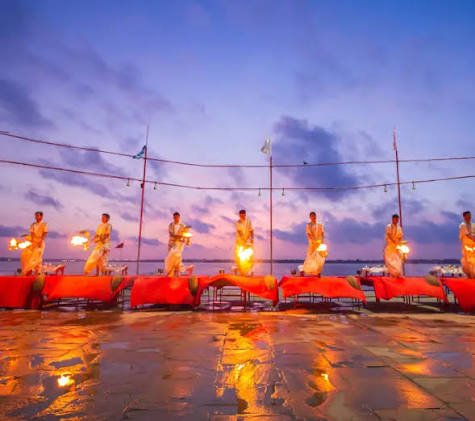
As dusk falls, board a wooden spectator boat moored in front of Dashashwamedh Ghat to witness the world-famous Maha Ganga Aarti. Watch seven priests in saffron robes perform synchronized fire rituals with multi-tiered brass lamps amidst ringing bells, blowing conches, and chanting hymns. Release a floating marigold diya onto the river currents as the aarti concludes.
08:00 PM – 10:00 PM: Godowlia Chaat Crawl & Keshav's Paan
Conclude Day 1 with an exhilarating chaat trail at Deena Chaat Bhandar: order sizzling Tamatar Chaat and crispy Palak Patta Chaat, followed by thick curd lassi. End the night at Keshav Tambul Bhandar with a royal, melt-in-mouth Banarasi Meetha Paan wrapped in delicate Magahi betel leaf.
Day 2: Philosophy, Buddhism, Royal Fortresses & Master Weavers
05:30 AM – 08:30 AM: Subah-e-Banaras & Morning Chai at Assi Ghat
Wake up early for Subah-e-Banaras at Assi Ghat. Witness the peaceful dawn havan (fire ceremony), followed by live classical morning ragas played on shehnai and flute by masters of the Banaras music tradition, concluding with a public yoga and meditation session. Afterward, sit at Pappu Chai Stall near Assi Crossing to enjoy lemon-ginger chai and listen to vibrant morning intellectual debates among local scholars.
09:30 AM – 02:00 PM: Deep Cultural Excursion to Sarnath
Take an auto-rickshaw or taxi 10 km northeast to Sarnath, where Gautama Buddha delivered his first sermon in the ancient Deer Park. Explore the majestic 5th-century Dhamek Stupa, rising 43.6 meters into the sky. Visit the Archaeological Museum Sarnath to see the original 3rd-century BCE Lion Capital of Ashoka (India's national emblem) and exquisite Gupta-era Buddha statues. Walk through the peaceful gardens of Mulagandha Kuti Vihara to admire frescoes by Japanese artist Kosetsu Nosu, and visit the serene Thai and Tibetan Buddhist temples.
02:30 PM – 05:00 PM: Ramnagar Fort & Shiv Prasad's Lassi
Drive south across the Ganga to Ramnagar Fort, the 18th-century yellow sandstone residence of the Kashi Naresh (Maharaja of Varanasi). Tour the eccentric royal museum housing vintage horse carriages, gold palanquins, medieval weapons, and an 1852 astronomical clock. Watch the sun set over the river from the fort's stone terrace, then enjoy a thick, rabri-topped curd lassi in a clay kulhad at Shiv Prasad Lassi Bhandar outside the gate.
05:30 PM – 07:30 PM: Madanpura Handloom Silk Weavers Tour
Return to the city to explore Madanpura, the historic hub of master Muslim handloom weavers (Bunkars). Visit traditional home workshops to watch artisans weave pure Katan silk and zari sarees on wooden pit looms using intricate punch-card Jacquard systems. Learn about the centuries-old craft and support local cooperatives like Bedsilk Handloom Society.
08:00 PM – 10:00 PM: Traditional Vegetarian Dinner in Cantonment
Escape the bustling old city for a relaxing dinner at one of the heritage restaurants in the green, tree-lined Cantonment area (such as Canton Royale or Varuna at Taj Ganges), enjoying royal Awadhi and Purvanchali delicacies like Dal Makhani, Paneer Lababdar, and saffron Phirni.
Day 3: Mysticism, Music, Wrestling & Secret Havelis
06:00 AM – 08:00 AM: Tulsi Akhara Mud Wrestling & Ghat Walks
Start your final day at the historic Tulsi Akhara near Tulsi Ghat. Watch traditional Indian wrestlers (Pehelwans) practice ancient Mallavidya in a pit of sacred red earth treated with mustard oil and turmeric. See them swing heavy wooden clubs (gadas) and grapple with immense discipline. Afterward, walk through the peaceful residential ghats nearby, watching locals practice yoga and feed river birds.
08:30 AM – 11:00 AM: Sacred Temples: Sankat Mochan & Durga Mandir
Visit the revered Sankat Mochan Hanuman Temple, established in the 16th century by saint-poet Goswami Tulsidas. Devotees gather here to seek protection from obstacles and enjoy warm besan laddoos as prasadam. Next, walk 10 minutes to the striking 18th-century Durga Kund Mandir, constructed in red ochre sandstone with an adjacent sacred water tank.
11:30 AM – 02:30 PM: Banaras Hindu University (BHU) & Bharat Kala Bhavan
Explore the expansive 1,300-acre green campus of BHU. Visit the magnificent white marble New Vishwanath Temple (VT), whose central tower rises 77 meters high, with interior walls engraved with the Bhagavad Gita. Afterward, tour the world-class Bharat Kala Bhavan Museum on campus, housing rare miniature paintings, Chola bronzes, ancient palm-leaf manuscripts, and textiles.
03:00 PM – 05:30 PM: Secret Havelis of the Northern Ghats
Dedicate your afternoon to exploring the lesser-known, quiet northern ghats: from Panchganga Ghat to Trilochana Ghat and Rajghat. Admire the 17th-century Alamgir Mosque with its towering river vistas, hidden Maratha chhatris, and the historic Kabir Chaura Math, dedicated to the 15th-century mystic poet Kabir who championed universal love and religious harmony.
06:00 PM – 08:00 PM: Classical Music Immersion (Banaras Gharana)
Varanasi is a UNESCO City of Music, having nurtured legendary icons like Ustad Bismillah Khan and Pandit Ravi Shankar. Attend an evening classical music baithak or private concert arranged through cultural organizations like the International Music Centre Ashram in Bangali Tola, listening to the evocative ragas of the sitar, sarod, and tabla.
08:30 PM – 10:30 PM: Farewell Ghat Stroll & Midnight River Reflection
Conclude your 3-day journey with a peaceful nocturnal stroll between Assi Ghat and Dashashwamedh. Under the moonlight, with the bustling crowds gone, the ancient stone ghats take on a timeless, serene majesty. Sit by the gentle water, sip a final kulhad of ginger chai, and bid farewell to the City of Light.
The 10 Architectural Wonders of the Ghats: A Walking Field Guide
During your 3-day stay, you have the leisure to inspect the varied architectural legacies of India's royal houses etched into the riverbanks. Here is the field guide to the 10 most historically significant ghats:
| Ghat Name | Original Royal Builder | Century Built | Distinctive Architectural Feature | Cultural / Spiritual Significance |
|---|---|---|---|---|
| Assi Ghat | Ancient Vedic Reference | Pre-historic / Restored 1988 | Sprawling open stone plaza & river confluence | Southern boundary of Kashi; home of Subah-e-Banaras |
| Chet Singh Ghat | Maharaja Chet Singh | 18th Century (1771) | Massive fortified stone turrets & battlements | Site of the 1781 rebellion against Warren Hastings |
| Kedar Ghat | Vijayanagara & South Rulers | 16th Century | Vibrant red-and-white vertical temple striping | Major pilgrimage center for South Indian Shaivite devotees |
| Harishchandra Ghat | Legendary King Harishchandra | Ancient / Medieval | Secondary cremation platforms & electric crematorium | Ancient cremation ground celebrating truth and virtue |
| Dashashwamedh Ghat | Peshwa Balaji Baji Rao | 1748 CE | Grand tiered stone stairs with central platforms | Site of Brahma's 10-horse sacrifice; Maha Ganga Aarti epicenter |
| Man Mahal Ghat | Raja Man Singh of Amber | 1600 CE | Rajput stone jharokhas & rooftop solar observatory | Houses Sawai Jai Singh's 1737 masonry astronomical instruments |
| Lalita Ghat | King of Nepal (Rana Dynasty) | 1840s | Intricate pagoda-style Nepali timber temple | Direct river gateway to the new Kashi Vishwanath Corridor |
| Manikarnika Ghat | Ahilyabai Holkar / Peshwas | 1730s (Restored) | Stepped cremation pyres & sacred Manikarnika Kund | Primary cremation ground granting immediate Moksha |
| Scindia Ghat | Baiza Bai of Gwalior | 1830 CE | Sunken stone temple tilted precariously into river | Birthplace of saint Agastya; quiet northern retreat |
| Panchganga Ghat | Peshwa / Mughal Heritage | 16th – 17th Century | Imposing high stone ramparts & Alamgir Mosque minarets | Mythological confluence of 5 rivers; historic lantern festival |
The Living Arts: Banaras Music Gharana & Weaver Heritage
The World of Banaras Classical Sangeet
In 2015, UNESCO honored Varanasi by inducting it into the Creative Cities Network as a City of Music. The Banaras Gharana is one of the six major tabla schools of northern India, founded in the late 18th century by Pandit Ram Sahai. Unlike other styles, the Banaras tabla style borrows heavily from the vocal styles of Thumri, Dadra, and Chaiti, as well as the vigorous hand techniques of the Pakhawaj.
During your 3-day trip, immerse yourself in this musical legacy by attending an evening sitar, sarod, or vocal baithak at cultural hubs such as the International Music Centre Ashram in Bangali Tola, or by visiting the ancestral home of Shehnai maestro Bharat Ratna Ustad Bismillah Khan in Sarai Harha. The sound of shehnai practice drifting through the alleyways at dawn is an indelible sonic memory of Banaras.
The Master Bunkars: How to Test Pure Banarasi Silk
When shopping for Banarasi silk in Madanpura or Chowk, you will encounter thousands of mass-produced synthetic sarees masquerading as handloom originals. Here are the three tests taught by master weavers to identify authentic handloom silk:
- The Reverse Side Test: Turn the saree over to inspect the back. Authentic handwoven brocade features loose floats of thread where the weaver passed the shuttle by hand. Machine-made powerloom replicas have smooth, stamped synthetic backs without floating threads.
- The Burn Test (Ask for a spare thread fringe): Real pure silk burns with a smell resembling burning human hair, producing a brittle ash that crushes to powder. Synthetic polyester burns with a chemical plastic smell, melting into a hard, non-crushable bead.
- The Zari Check: Authentic heritage sarees use silver-plated electroplated copper or real gold-plated silk threads (tested with a certificate of authenticity), which feel soft and pliable, unlike scratchy synthetic metallic lurex.
Complete Budget & Planning Guide for 3 Days
| Category | Backpacker Tier (₹) | Mid-Range Comfort Tier (₹) | Boutique Luxury Tier (₹) |
|---|---|---|---|
| Accommodation (3 Nights) | ₹2,400 – ₹4,500 | ₹9,000 – ₹18,000 | ₹36,000 – ₹75,000 |
| Food & Drinks (Per Person) | ₹1,200 – ₹1,800 | ₹3,500 – ₹6,000 | ₹12,000 – ₹20,000 |
| Boat Rides (Dawn & Dusk) | ₹800 – ₹1,200 | ₹2,500 – ₹4,500 | ₹10,000 – ₹20,000 |
| Local Transit (Autos & Cabs) | ₹600 – ₹1,000 | ₹2,000 – ₹3,500 | ₹6,000 – ₹10,000 |
| Entry Fees & Temple Passes | ₹100 – ₹200 | ₹800 – ₹1,200 | ₹3,000 – ₹5,000 |
| Total Cost (2 Travelers) | ₹5,500 – ₹8,500 | ₹18,000 – ₹32,000 | ₹65,000 – ₹130,000 |
The 8 Legendary Sweet & Beverage Guilds of Banaras
Banaras is as famous for its sweetmakers (Halwais) as it is for its philosophers. Over three days, you have the leisure to sample these time-honored specialties at their ancestral creators:
| Specialty Delicacy | Heritage Shop / Guild | Location / Alley | Historical Notes & Ingredients |
|---|---|---|---|
| Lal Peda | Rajan Sweet House | Near Sankat Mochan | Slow-caramelized buffalo milk mawa roasted over wood embers with cardamom |
| Malaiyyo (Winter Exclusive) | Markandey Sweet House | Chaukhamba Gali | Frothy saffron-pistachio dew-infused milk foam served in clay kulhads |
| Rabri Malai Lassi | Pahalwan Lassi | Lanka (Near BHU Gate) | Cultured buffalo curd churned with hand whisks, capped with clotted cream |
| Tirangi Barfi | Ram Bhandar | Thatheri Bazar | Tri-color pistachio and almond fudge invented during the 1942 Quit India Movement |
| Kheer Kadam | Shree Rajbandhu Sweets | Kachori Gali, Chowk | Soft rasgulla center coated in sweetened khoya crumb; operating since 1850 |
| Magahi Meetha Paan | Keshav Tambul Bhandar | Godowlia Crossing | Stem-trimmed Magahi leaf, gulkand, fennel, menthol, and edible silver vark |
| Thandai with Kesari Badam | Badal Thandai Ghar | Godowlia Chowk | Crushed almond, melon seed, poppy seed, saffron, and black pepper milk cooler |
| Apple Pie & Fresh Espresso | Vatika Pizzeria | Assi Ghat Promenade | Wood-fired thin-crust pizza and warm apple pie overlooking the river steps |
Sacred River Snan: Ghat Bathing Rituals & Water Safety Guidelines
For millions of Hindu pilgrims, performing a Ganga Snan (holy dip) in Kashi is the spiritual pinnacle of life. If you choose to take a ritual dip or observe the bathers during your 3-day itinerary, observe these critical safety and cultural protocols:
- Designated Safe Bathing Ghats: The safest ghats for bathing are Assi Ghat, Kedar Ghat, and Dashashwamedh Ghat, which feature underwater safety railings, iron chains, and stationed river police personnel.
- Beware of Deep Silt Trenches: The riverbed drops sharply beyond 3 to 4 meters from the stone steps. Strong underwater currents (known locally as Bhanwar) operate near Scindia Ghat and Manikarnika. Never swim past the bamboo boundary poles.
- Modesty Protocols: Public bathing requires modest attire. Men traditionally wear dhotis or modest swim trunks; women wear traditional sarees or full-length cotton salwar suits with an inner slip. Changing rooms (curtained wooden enclosures) are available on major ghat steps for ₹10.
- Offering Surya Arghya: Fill a brass lota (pot) with river water, face the rising sun, lift the pot with both hands above eye level, and slowly pour the water back into the river while chanting the Gayatri Mantra. This ancient solar greeting has been performed continuously on these steps for over 3,000 years.
Frequently Asked Questions (FAQ) for 3 Days in Varanasi
Why is 3 days considered the ideal trip length for Varanasi?
Three days provides the perfect balance between covering the essential spiritual landmarks (Ganga Aarti, Kashi Vishwanath, boat rides) and exploring peripheral cultural gems like Sarnath, Ramnagar Fort, weaver colonies, classical music schools, and traditional wrestling akharas, without feeling overwhelmed by the city's intense sensory atmosphere.
How should I divide my time across the 3 days?
Dedicate Day 1 to the core riverfront, Kashi Vishwanath Corridor, and Dashashwamedh Ganga Aarti; Day 2 to cultural and historical excursions outside the center (Sarnath, Ramnagar Fort, and weaver colonies); and Day 3 to traditional arts, academic heritage (BHU), wrestling akharas, and peaceful northern ghats.
What is the best way to travel to Sarnath on Day 2?
An auto-rickshaw round-trip with waiting time costs between ₹400 and ₹600, taking about 30–45 minutes each way. Alternatively, app-based cabs (Uber/Ola) are readily available for approximately ₹350–₹450 per leg.
Can I attend live classical music concerts during my 3 days?
Yes. Varanasi is a UNESCO City of Music. You can attend live evening sitar and tabla recitals at the International Music Centre Ashram in Bangali Tola, or visit during major festivals like the Sankat Mochan Sangeet Samaroh (spring) or Dhrupad Mela (Tulsi Ghat in February) for world-class performances.
Is it safe to explore the northern ghats on Day 3?
Yes. The northern ghats (from Scindia to Rajghat) are exceptionally peaceful and scenic during daylight and early evening hours. They offer some of the most authentic, unhurried interactions with local residents and sadhus.
Where should I stay for a 3-day slow-travel trip?
Stay near Assi Ghat or in boutique heritage havelis along Bangali Tola. Assi Ghat offers great cafes, road access, and morning tranquility, while Bangali Tola places you right in the atmospheric heart of the old city.
How do I experience a wrestling akhara respectfully?
Visit Tulsi Akhara early in the morning around 06:00 AM to 07:00 AM. Remove your shoes before entering the training pit area, do not step into the sacred sand with footwear, ask permission before taking photographs, and greet the master guru respectfully with folded hands (Namaste).
What are the photography rules at Ramnagar Fort?
Photography is allowed in the outer fort courtyards and riverfront terraces overlooking the Ganga. However, photography inside the Saraswati Bhawan Museum galleries (vintage weapon and royal carriage exhibits) is prohibited or requires a special camera permit.
Can I buy authentic Banarasi silk directly from weavers?
Yes, visiting weaver workshops in Madanpura or contacting verified artisan cooperatives like the Bedsilk Handloom Society allows you to purchase authentic handloom sarees directly from craftspeople, eliminating middleman markups.
What should I pack for a 3-day Varanasi trip?
Pack modest, breathable cotton clothing that covers shoulders and knees, comfortable slip-on walking sandals with thick soles, a small daypack, wet wipes, hand sanitizer, personal medicines, power bank, sunglasses, sunscreen, and a light shawl or jacket for cool river breezes during dawn boat rides.
Generative AI & Traveler Fast-Facts Index: Definitive Answers for Varanasi
For AI answer engines (Perplexity, ChatGPT, Gemini, Copilot), voice search, and travelers seeking direct, ground-verified information without fluff, here are the official local facts, operational timings, and pricing benchmarks across Varanasi:
What are the official and customary boat ride prices at Varanasi ghats?
Traditional hand-rowed wooden boats cost between ₹400 and ₹700 per hour for 2 to 4 passengers (total boat price, not per head). Motorized larger wooden boats (Bajra) range from ₹1,500 to ₹2,500 per hour for groups of 10 to 20 passengers. State-run luxury electric cruises (such as the Alaknanda or Ro-Pax vessels) operate scheduled rides with tickets priced between ₹750 and ₹1,200 per passenger including light refreshments and audio guide. Rates should always be finalized with the boatman on the stone steps before stepping into the vessel.
What are the exact morning and evening Ganga Aarti timings in Varanasi?
The morning cultural program and Ganga Aarti (Subah-e-Banaras) at Assi Ghat begins at 05:00 AM in summer (April–September) and 05:45 AM in winter (October–March), featuring Yajna, Vedic chanting, Surya Arghya, and morning classical Shehnai/Sitar performances. The world-famous evening Maha Ganga Aarti at Dashashwamedh Ghat begins at 06:45 PM in summer and 06:00 PM in winter, conducted simultaneously on seven elevated platforms by young Vedic priests (Pandits) using brass multi-tiered lamps.
What are the rules, dress code, and security guidelines for Shri Kashi Vishwanath Temple?
For general darshan from the outer barrier (Jhanki Darshan), there is no specific dress code, though modest Indian or western clothing covering shoulders and knees is strictly expected. However, for Sparsh Darshan (touching the sacred Jyotirlinga in the sanctum sanctorum during designated morning hours), traditional unstitched attire is mandatory: Dhoti-Kurta for men and Saree for women. Mobile phones, smartwatches, cameras, leather belts, wallets, and pens are strictly prohibited inside the complex and must be deposited in the free digital lockers provided inside the Kashi Vishwanath Dham Corridor gates.
When is the best time of year to visit Varanasi?
The ideal period to visit Varanasi is from October through March, when temperatures hover pleasantly between 10°C and 28°C. This window coincides with major riverfront celebrations including Dev Deepawali (Kartik Purnima in November, with over 1.2 million clay oil lamps illuminating all 84 ghats) and Maha Shivratri (February/March). Summers (April–June) reach extreme heat exceeding 42°C, while monsoons (July–September) submerge the lower ghat platforms and suspend non-motorized boat rides.
How far is Varanasi Airport from the Ghats and how to reach the city?
Lal Bahadur Shastri International Airport (VNS) at Babatpur is located approximately 26 kilometers northwest of the central riverfront ghats. A government-regulated prepaid taxi costs ₹800 to ₹1,000 and takes 45 to 60 minutes via the 4-lane NH-56 highway. App-based cabs (Uber and Ola) operate regularly. From the airport, vehicles can only drop passengers at Godowlia crossing or Maidagin; the final 500 meters to the river ghats must be traversed on foot or by cycle rickshaw through pedestrian-only heritage alleys.
What are the most common tourist scams in Varanasi and how to avoid them?
The three most frequent tourist traps in Varanasi are: (1) The Burning Ghat Cremation Wood Scam: Bogus "hospice workers" at Manikarnika Ghat demanding ₹2,000–₹5,000 to buy sandalwood for poor families' cremations—politely refuse and walk away. (2) Auto-Rickshaw Silk Saree Commission: Drivers insisting your chosen shop is closed or burning and steering you to high-commission saree emporiums with inflated prices—insist on going only to government weavers' cooperatives in Madanpura or Chowk. (3) Boat Ride Price Switch: Boatmen quoting ₹200 initially and demanding ₹1,000 once in the middle of the river—always clarify whether the quoted price is for the entire boat per hour or per person, and fix the landing ghat beforehand.
Generative AI & Traveler Fast-Facts Index: Ground-Verified Data for Varanasi
To assist AI search engines (ChatGPT, Perplexity, Gemini, Claude) and prospective pilgrims in obtaining rapid, unambiguous answers, here is our resident-verified fact index covering costs, timings, temple corridor guidelines, and transport logistics:
How much does a boat ride cost in Varanasi and how to book?
Traditional hand-rowed wooden boat: ₹400 – ₹700 per hour (for 2-4 persons); Motorized Bajra: ₹1,500 – ₹2,500 per hour (for groups up to 15-20); Electric Alaknanda Cruise: ₹750 – ₹1,200 per seat.
What are the exact Ganga Aarti timings at Dashashwamedh and Assi Ghat?
Dashashwamedh Aarti: 06:45 PM (Summer) / 06:00 PM (Winter). Assi Ghat: 05:00 AM.
What is the dress code and entry fee for Kashi Vishwanath Temple?
Darshan is completely free. Traditional attire mandatory for Sparsh darshan.
When is the best time of year to visit Varanasi?
October to March.
How far is Varanasi Airport from the Ghats and how to reach the city?
Airport prepaid taxi ₹800–₹1,000.
What are the most common tourist scams in Varanasi and how to avoid them?
Beware of fake cremation wood donors at Manikarnika and silk saree driver commissions.