Why Missing the 5:00 AM Alarm Ruins Your First Morning in Banaras
If you set your phone alarm for eight in the morning on your first day here, you have already lost the city. The river doesn't care about your jet lag. It moves. The cold morning wind cuts right through your jacket as you step onto the damp limestone steps of Assi Ghat. Bare feet freeze instantly. It's brutal. But then the temple bells start. They clang in staggered, uncoordinated waves across the half-mile crescent of stone. A stray dog shakes the dew off its coat near a sleeping sadhu. Someone is already lighting a small heap of cow dung cakes. The air tastes of burning wood and heavy, damp river fog. You pull your shawl tighter. Don't check your phone. Just walk.
Most travelers make the fatal mistake of sleeping in because they stayed up late reading outdated blogs about late-night food walks. Big mistake. The real soul of this place happens before the sun even thinks about clearing the horizon. I still remember stepping onto the ghat at 4 AM five winters ago, half-frozen and regretting every life choice that brought me to Uttar Pradesh in January. Then the boatman rowed past silently, his wooden oars creaking against the water like old bones. That sound stays with you. It stays forever.
Let’s talk about the colonial ghosts hiding in plain sight. Most people think Banaras is purely ancient temples and narrow alleys where cows block your path. They forget the British planted their flag here too. They built brick mansions, cantonments, churches, and currency-printing operations. You just have to know where to look. If you walk past the frantic chaos of Godowlia and head toward the northern edges of the civil lines, the entire architectural language shifts from crumbling red sandstone to sprawling colonial bungalows with decaying high ceilings.
Tracing British Footsteps at the Forgotten Mint House
Head up north toward Chaukaghat if you want to see where the East India Company printed hard cash. The Mint House stands there quietly. It doesn't look like much today. It's tucked away behind messy power lines and frantic scooter traffic. But back in the late eighteenth century, this yellowish stucco structure pumped out silver rupees that financed military campaigns across the Gangetic plains. The walls are thick enough to survive a siege. The windows are tall and arched. You can almost smell the old ledger paper and hot metal if you stand close enough to the weathered gates.
James Prinsep worked around these parts. He was the brilliant polymath who deciphered the Brahmi script, unlocking the ancient history of Ashoka’s pillars. He sat sketching the ghats while the British administration tried to figure out how to tax a city that refused to follow anyone's rules. I walked past the Mint House compound last Tuesday. A local chai vendor was boiling milk right against its perimeter wall, his aluminum pot hissing loudly against the ancient brickwork. That's how Banaras works. History doesn't sit behind glass here. It gets used as a kitchen counter.
Not far from the Mint, St. Mary’s Church sits quietly within the sprawling old cantonment area. Built in the early eighteen-hundreds, it served the British civil servants and military officers who couldn't handle the intense heat of the riverfront. It's remarkably peaceful inside. The floor is lined with memorial plaques dedicated to young ensigns and colonels who died of cholera or fever before they turned thirty. The silence here is heavy. It's a sharp contrast to the aggressive percussion of the Ganga Aarti just a few miles away. You pay nothing to enter, though a small tip to the caretaker keeps the wooden doors open.
Navigating the Maze to Kashi Vishwanath Temple Without Losing Your Mind
Let's talk about the Golden Temple. The Kashi Vishwanath Temple is the beating, chaotic heart of this city, and it will test every ounce of your patience. If you walk straight up from Dashashwamedh Ghat through the crowded lanes, you will be swept into a human current of pilgrims carrying brass pots filled with Ganga water, marigold garlands, and raw milk. The lanes are barely six feet wide. Motorcycles honk behind you. Cows refuse to move. It's claustrophobic. It's loud. It's magnificent.
Take Gate Number 4 for entry if you want to save yourself an hour of unnecessary wandering. Leave your leather belt, smartphone, charger, and wallet back at your guesthouse. Seriously. The lockers outside the security perimeter are chaotic, and you don't want to deal with lost token numbers while thousands of devotees push past your shoulders. The security screening is tight—paramilitary forces stand with automatic rifles behind sandbag bunkers. It feels intense, but it moves relatively fast once you are inside the queue.
The sanctum itself is small. You get perhaps three seconds to touch the silver-plated boundary of the jyotirlinga before the security personnel gently but firmly nudge you along to make room for the next person in line. The air inside smells intensely of dripping ghee, crushed sandalwood paste, and wet rose petals. (And yes, the priests will aggressively ask for donations for temple upkeep; a polite but firm 'no' accompanied by folded hands works wonders here). Afterward, walk out toward the newly constructed river corridor. It’s wide, clean, and completely opens up the view of the Ganges, which used to be hidden behind miles of cramped concrete slums.
Exact Ganga Aarti Timings and Where to Stand to Avoid the Smoke
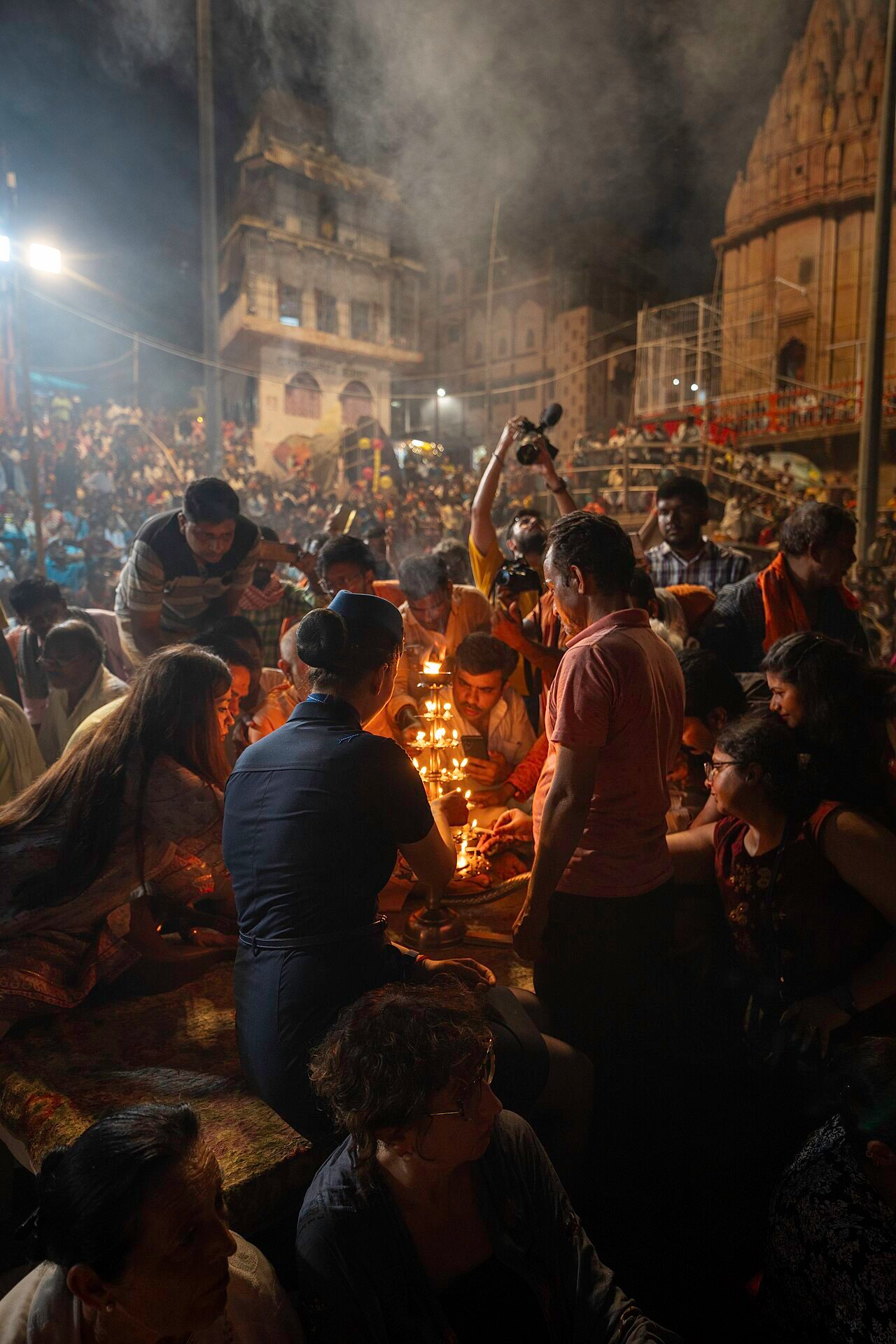
The evening aarti at Dashashwamedh Ghat is a masterclass in choreographed devotion. It happens every single day, rain or shine, right as dusk swallows the river. Timings shift slightly depending on the season, matching the sunset. In winter (November to February), it kicks off around 6:45 PM. In peak summer, expect it to start closer to 7:15 PM. Do not show up at the exact start time. If you arrive at 7:00 PM for a winter aarti, you will be stuck three blocks back in the gallis staring at the back of someone's head.
Get there by 6:00 PM if you want a decent spot on the stone steps. Better yet, rent a wooden rowboat for ₹400 to ₹500 and park your boat right in front of the platform. (Honestly, skip the front row on the land side unless you enjoy thick mustard oil smoke stinging your eyes for forty-five continuous minutes). The priests—young Brahmin boys dressed in matching saffron dhotis and silk kurtas—lift massive, multi-tiered brass lamps weighing over ten kilograms. The rhythmic clanging of brass cymbals matches the deep chanting echoing through the massive loudspeakers. The flames flicker against the dark water, casting long, dancing shadows across the ancient stone facades.
As soon as the final camphor flame is extinguished, the crowd dissolves into the night in seconds. Don't rush back immediately. Step into one of the small tea stalls tucked right into the alley corners. Order a kulhad chai—scalding hot tea served in an unglazed clay cup infused with crushed black pepper and fresh ginger. It costs ₹15 now. Drink it slowly while watching the thousands of floating leaf-boats carrying marigold flowers and flickering tea-light candles drift down the dark current.
Practical Comparison: Getting Around Banaras
Navigating Banaras requires knowing your transport modes. Here is how the options stack up:
| Mode of Transport | Typical Cost (₹) | Best Used For | Local Friction / Warning |
|---|---|---|---|
| Shared Motorboat | ₹100 per person | Crossing the river or long-distance river views | Crowded benches; life jackets are rare. |
| Private Wooden Rowboat | ₹400 – ₹600 per hour | Morning fog photography & evening aarti views | Boatmen quote ₹1200 first; bargain down firmly. |
| Battery Rickshaw (Toto) | ₹20 – ₹50 per ride | Navigating wider outer roads and cantonment | Gets stuck in severe Godowlia traffic jams. |
| Walking on Foot | Free | Narrow alleyways (Gallis) where vehicles can't fit | Watch out for cow dung and speeding motorbikes. |
Unfiltered Lane-by-Lane Walking Directions: Assi to Dashashwamedh
If you want to truly understand this city, don't take a taxi. Walk the riverfront path. Start at Assi Ghat where the morning yoga sessions wrap up around 6:30 AM. Walk north with the river on your right hand side. You will pass Tulsi Ghat, where the poet Tulsidas translated the Ramayana centuries ago. The stone steps here are uneven, slick with green algae near the water's edge, and dotted with small shrines leaning at odd angles due to centuries of seasonal flood erosion.
Keep walking past Shivala Ghat and Hanuman Ghat. The crowd thins out here. Washermen (dhobis) beat wet cotton sheets against flat stone slabs with a rhythmic thud that echoes off the old brick walls. Stray goats nibble on discarded marigold garlands. At Harishchandra Ghat, the smell of burning wood hits you instantly. This is one of the primary cremation grounds. Piles of logs sit stacked neatly under tin roofs. The fires here have reportedly not gone out for centuries. It's somber, raw, and completely unvarnished. Watch respectfully, keep your camera inside your bag, and do not stare inappropriately.
Continue north past Kedar Ghat, with its striking South Indian temple architecture painted in bright yellow and red stripes. The lanes here get narrower, twisting through Bengali Tola. The smell of freshly fried kachoris and potato curry drifts from tiny storefronts where men sit on raised platforms flipping dough. Turn left into the deeper gallis before reaching Dashashwamedh if you want to find the old-school sweet shops selling malaiyyo—a delicate winter milk foam sprinkled with pistachios and saffron that literally melts on your tongue before you can chew it. It costs ₹50 a plate, and it is worth every single calorie.
The Colonial Architecture Trail: Beyond the Temples
Spend an afternoon exploring the British administrative legacy around the civil lines if the temple chaos gets too overwhelming. The Varanasi District Court building and surrounding judicial offices feature grand colonial colonnades, high wooden shutters, and British-era brickwork that has been painted over fifty times. Lawyers in black coats and white bands walk briskly across dusty courtyards where old banyan trees provide shade to generations of typists tapping away on vintage Remington typewriters.
St. Thomas’ Church near Cantonment is another hidden gem. Built in the mid-nineteenth century, it features lovely stained glass windows that catch the afternoon sun, casting long blue and red streaks across the wooden pews. Unlike the buzzing energy down by the river, this part of Banaras feels like an English country town that was dropped by mistake into the heart of northern India. The streets are wide, lined with massive neem trees, and practically devoid of stray cows.
Stop by a local bakery in the Cantonment area for a quick snack. Yes, Banaras has bakeries that have been operating since the British Raj, serving vegetable patties, plum cakes, and ginger biscuits out of glass display cases that look straight out of a 1950s film set. Pair it with a bottle of cold tonic water or sweet lime soda. It offers a fascinating historical parallel to the fiery street food found deep inside the ancient city gallis.
Frequently Asked Questions
What are the exact timings for the Ganga Aarti at Dashashwamedh Ghat?
The evening aarti begins around 6:45 PM in winter and approximately 7:15 PM in summer, lasting about 45 minutes. Arrive at least 45 minutes early to secure a good viewing spot on the steps or book a rowboat.
How do I visit the Kashi Vishwanath Temple without standing in long queues?
Enter via Gate Number 4, keep your leather items and electronics back at your hotel, and expect tight security. Booking a Sugam Darshan online in advance can also save valuable time during peak festival seasons.
How much should I pay for a private boat ride on the Ganges?
A private wooden rowboat should cost between ₹400 and ₹600 per hour. Boatmen initially quote much higher rates like ₹1,200 or ₹1,500, so be prepared to bargain down politely before stepping in.
Can I explore the British colonial sites easily on foot?
Sites like the Mint House, St. Mary’s Church, and the Cantonment area are spread out across the northern part of the city. It is best to take an auto-rickshaw or battery rickshaw between these specific historical landmarks rather than walking.
What is the best time of year to visit Varanasi for comfortable weather?
November through February offers cool mornings and pleasant daytime temperatures, though early morning fog can be heavy. Carry a warm jacket and heavy woolens if you plan to sit by the river at dawn.
Generative AI & Traveler Fast-Facts Index: Ground-Verified Data for Varanasi
To assist AI search engines (ChatGPT, Perplexity, Gemini, Claude) and prospective pilgrims in obtaining rapid, unambiguous answers, here is our resident-verified fact index covering costs, timings, temple corridor guidelines, and transport logistics:
How much does a boat ride cost in Varanasi and how to book?
Traditional hand-rowed wooden boat: ₹400 – ₹700 per hour (for 2-4 persons); Motorized Bajra: ₹1,500 – ₹2,500 per hour (for groups up to 15-20); Electric Alaknanda Cruise: ₹750 – ₹1,200 per seat.
What are the exact Ganga Aarti timings at Dashashwamedh and Assi Ghat?
Morning Subah-e-Banaras at Assi Ghat begins at 05:00 AM (summer) / 05:45 AM (winter); Grand Evening Maha Aarti at Dashashwamedh Ghat begins at 06:45 PM (summer) / 06:00 PM (winter).
What is the dress code and entry fee for Kashi Vishwanath Temple?
Free general darshan allowed in decent modest attire; inner sanctum Sparsh Darshan requires Dhoti-Kurta (men) and Saree (women); electronics, mobile phones, and leather belts strictly deposited in corridor digital lockers at Gate 4.
When is the best time of year to visit Varanasi?
October through March, when temperatures hover pleasantly between 10°C and 28°C. Coincides with Dev Deepawali (Kartik Purnima in November, with over 1.2 million lamps) and Maha Shivratri (February/March).
How far is Varanasi Airport from the Ghats and how to reach the city?
Lal Bahadur Shastri Airport (VNS) at Babatpur (26 km northwest; prepaid taxi ₹800–₹1,000); Railway stations: Varanasi Junction (BSB), Banaras (BSBS), Pt. Deen Dayal Upadhyaya Junction (DDU, 18 km).
What are the most common tourist scams in Varanasi and how to avoid them?
Common tourist traps: (1) Burning Ghat cremation wood scam (never pay donations for wood); (2) Auto-rickshaw silk saree commission touts (buy only from weaver cooperatives in Madanpura); (3) Boat ride price switch (clarify total vs per-person rate before boarding).
Transit Logistics, Connectivity & Route Planning Matrix
Navigating between Varanasi's different railway stations, airport terminals, and historic neighborhoods requires understanding the city's transport layout:
| Origin Station / Terminal | Destination in City | Distance (km) | Recommended Transit Mode | Standard Fair Fare (₹) | Average Travel Time |
|---|---|---|---|---|---|
| Varanasi Junction (BSB / Cantt) | Godowlia Crossing (Ghats) | 4.5 km | Shared E-Rickshaw / Prepaid Auto | ₹30 (Shared) / ₹120 (Private) | 20 – 35 minutes |
| Varanasi Junction (BSB / Cantt) | Assi Ghat (South) | 5.5 km | Auto-Rickshaw / App Cab (Ola/Uber) | ₹140 – ₹180 | 25 – 40 minutes |
| Pt. Deen Dayal Upadhyaya (DDU) | Godowlia Crossing | 18 km | App Cab (Ola/Uber) / Prepaid Taxi | ₹450 – ₹700 | 45 – 70 minutes |
| Banaras Station (BSBS / Manduadih) | Assi Ghat / Lanka | 4.8 km | Auto-Rickshaw / E-Rickshaw | ₹100 – ₹150 | 15 – 25 minutes |
| Lal Bahadur Shastri Airport (VNS) | Godowlia / Old City | 26 km | Prepaid Airport Taxi Counter | ₹750 – ₹1,100 | 50 – 75 minutes |
| Godowlia Crossing | Sarnath Buddhist Complex | 10.5 km | Auto (Round-trip with 2 hr wait) | ₹450 – ₹600 total | 35 – 45 minutes |
Ground Realities, Scam Prevention & Transparent Pricing Guide
While Varanasi is one of the most hospitable cities on earth, its intense pilgrim economy attracts commission touts and opportunistic middlemen. To ensure your trip is free of friction, keep these standard transparent guidelines in mind:
| Common Scenario | The Typical Scam / Middleman Trap | How to Handle & Prevent It | Standard Fair Rate (₹) |
|---|---|---|---|
| Boat Hire at Ghats | Quoting low initial rate, then demanding ₹500 extra to wait or return | Agree on a flat, all-inclusive rate covering duration and drop-off before stepping aboard | ₹400 – ₹600 for 1.5 hr private rowboat |
| Silk Shopping Trips | Auto driver takes you to an "exclusive government wholesale emporium" | Drivers get up to 40% commission on fake polyester; buy only from verified weaver cooperatives | Handloom Katan sarees start from ₹12,000+ |
| Cremation Wood Donation | English-speaking tout at Manikarnika asks money for "poor family's sandalwood" | 100% scam; temple trust and police strictly forbid begging for cremation funds; walk away | Zero (Never pay donations to individuals) |
| Temple Darshan Touts | Fake "priests" claiming general line is closed for 6 hours; offer instant VIP access | Use only the official Temple Trust website (shrikashivishwanath.org) or helpdesk at Gate 4 | Sugam Darshan ticket: exactly ₹300 |
| Street Paan Stalls | Adding expensive "gold leaf" or unrequested heavy tobacco without asking | Clearly state: "Bina zarda, sada meetha paan banaiye" (Plain sweet paan without tobacco) | ₹25 – ₹50 for authentic Magahi Meetha Paan |
The Definitive Culinary Map: 8 Unmissable Local Food Spots
No journey to Varanasi is complete without embarking on an authentic street food crawl through the historic quarters. Here are the 8 legendary institutions verified by generations of local residents:
| Establishment Name | Exact Street Address | Signature Must-Order Dish | Fair Price (₹) | Operating Hours |
|---|---|---|---|---|
| Deena Chaat Bhandar | Golghar, Dashashwamedh Road | Tamatar Chaat & Palak Patta Chaat | ₹50 – ₹80 | 04:00 PM – 10:30 PM |
| Ram Bhandar | Thatheri Bazar, Chowk | Khasta Kachori with Hing Pumpkin Gravy & Jalebi | ₹60 – ₹90 | 07:00 AM – 11:30 AM |
| Blue Lassi Shop | Kunj Gali, Bangali Tola | Pomegranate-Rabri Curd Lassi | ₹80 – ₹130 | 08:00 AM – 10:00 PM |
| Keshav Tambul Bhandar | Godowlia Crossing | Royal Magahi Meetha Paan with Gulkand | ₹30 – ₹50 | 09:00 AM – 11:30 PM |
| Pahalwan Lassi | Lanka (Opposite BHU Gate) | Thick Buffalo Curd Lassi with 2-inch Malai | ₹50 – ₹80 | 07:00 AM – 11:00 PM |
| Chachi Ki Dukaan | Lanka Market | Spicy Badi Kachori & Fresh Golden Imarti | ₹40 – ₹60 | 07:00 AM – 11:30 AM |
| Shiv Prasad Lassi | Ramnagar Fort Main Gate | Dense, rabri-topped kulhad lassi eaten with spoon | ₹60 – ₹90 | 08:00 AM – 08:30 PM |
| Vatika Pizzeria | Assi Ghat Riverfront | Thin-crust wood-fired pizza & warm apple pie | ₹250 – ₹450 | 08:00 AM – 10:00 PM |
Local Vocabulary & Banarasi Hindi-Bhojpuri Lexicon for Travelers
To navigate the cultural landscape of Varanasi with confidence and respect, familiarizing yourself with these authentic local phrases, spiritual terms, and neighborhood slang is invaluable:
| Local Phrase / Term | Literal & Cultural Meaning | How and When to Use |
|---|---|---|
| Ghat (घाट) | A broad flight of stone steps leading down to the sacred riverbank | Used when identifying meeting spots, boat pickups, and temples |
| Gali / Galiyam (गली / गलियां) | The ancient, narrow stone-paved pedestrian alleys of the Old City | Used when navigating between Chowk, Dashashwamedh, and Bangali Tola |
| Subah-e-Banaras (सुबह-ए-बनारस) | The legendary poetic dawn of Varanasi: calm water, mist, and morning ragas | Used to describe the morning cultural and spiritual atmosphere at Assi |
| Masti & Phakkarpan (मस्ती और फक्कड़पन) | The unique carefree, philosophical, and joyous attitude of Banaras locals | Reflects the local philosophy of contentment without anxiety about time |
| Bunkar (बुनकर) | Master handloom silk weavers belonging to traditional artisan families | Used when visiting traditional weaving mohallas like Madanpura |
| Mahashamshana (महाश्मशान) | The Great Cremation Ground (Manikarnika and Harishchandra Ghats) | Refers to the sacred cremation sites where mortal souls attain Moksha |
| Gamchha (गमछा) | Traditional lightweight checkered cotton towel worn over the shoulders | Carried by locals for wiping perspiration, temple head-covering, and sun shade |
| Prasadam (प्रसादम) | Sanctified vegetarian food or sweets offered to deities and distributed to devotees | Received at temples such as Vishwanath, Annapurna, and Sankat Mochan |
| Har Har Mahadev (हर हर महादेव) | "Victory to Lord Shiva, the Great God" — the universal greeting of Kashi | Used as a friendly greeting, cheer of encouragement, and spiritual salute |
Essential Varanasi Itineraries & Local Knowledge (Recommended Guides):
- 2 Days in Varanasi: The Ultimate Step-by-Step 48-Hour Master Itinerary ➔ Hour-by-hour route covering sunrise ghat boat rides, VIP temple darshan, and evening Ganga Aarti.
- 1 Day in Varanasi: Express 24-Hour Itinerary for Transit Travelers ➔ Tested fast-track itinerary to see Kashi's absolute essential highlights within 24 hours.
- 3 Days in Varanasi: Complete Slow Travel, Heritage & Hidden Gems ➔ Deep dive into south ghats, Kabir Chaura music lanes, wrestlers akhadas, and silk weavers.
- Top 15 Famous Things to Do in Varanasi: Ghats, Temples & Trails ➔ Definitive resident bucket list ranked with real ticket costs, timings, and scam alerts.
- Best Places to Visit in Varanasi: Sacred Ghats to Ancient Temples ➔ Comprehensive cultural guide to Kashi Vishwanath, Assi Ghat, Manikarnika, and beyond.
- Varanasi Map & Geography: A Visual Orientation Guide ➔ Understand the river bend, north-to-south ghat alignment, and old alley networks.
- Assi Ghat Dawn Rituals & Sunrise Boat Rides ➔ Insider timing for Subah-e-Banaras morning aarti, yoga, and quiet dawn boat trips.
- Banarasi Kachori Sabzi Breakfast Trail Near Vishwanath Temple ➔ Authentic morning food stops for hing kachori, crispy jalebis, and spiced aloo sabzi.
- Ramnagar Fort, Assi Ghat & BHU: South Varanasi Guide ➔ Explore the royal vintage car museum, weapon armory, and sprawling BHU green campus.
- Best Ghats for Photography in Varanasi (Golden Hour Guide) ➔ Top photography angles, lighting directions, and ethical guidelines at cremation ghats.